Septic Systems on Rocky Limestone Ground in Lincoln County KS
If you're out in Lincoln County and you've been told your property is too rocky for a standard septic system — or you're buying land near Minneapolis, Sylvan Grove, or Lincoln and trying to figure out what a septic install is actually going to take — this post is for you. Post Rock limestone country is beautiful, but it does not give up ground easily, and the wrong system design will cost you far more than doing it right the first time.
Lincoln County sits right in the heart of Post Rock country. That stone fence post limestone that runs through the Smoky Hills isn't just a scenic feature — it's what's under your feet when you're trying to install a septic system. Designing a system on rocky ground here is a different conversation than installing one in the river bottom clay of Ottawa County or the sandy loam closer to Salina. This guide covers what that actually means for rural homeowners, what system types hold up best through Kansas freeze-thaw cycles, how often you need to pump, and what it looks like when something goes wrong and you're dealing with a backup inside the house.
What Rocky Post Rock Limestone Ground Actually Means for Septic Design
When people call us about a septic install out in Lincoln County, one of the first things we talk about is what's under the surface. In a lot of this area, you hit limestone ledge within a foot or two of topsoil. That changes everything about how a system gets designed and installed.
A conventional gravity-fed septic system with a standard drain field depends on soil depth and percolation — water has to move through the ground slowly enough to be treated but fast enough not to pond. When you're sitting on shallow limestone, you may not have enough soil depth for a conventional drain field to work at all. That's not a problem that goes away with a bigger tank or more lateral lines. It's a site condition that has to be engineered around from the start.
This is why a perc test and a site evaluation matter more on rocky Lincoln County ground than they do in easier digging areas. We've been out to properties where the homeowner was quoted a standard system by someone who never walked the site. That's a problem waiting to happen.
Best Septic Tank Types for Kansas Freeze-Thaw Conditions
Kansas winters aren't the worst in the country, but freeze-thaw cycles out here are real. The frost line runs 24 inches minimum for buried lines in Central Kansas, and a hard winter followed by a wet spring puts stress on older systems, cracked inlet baffles, and shallow lateral lines that weren't installed with enough cover.
Concrete Tanks
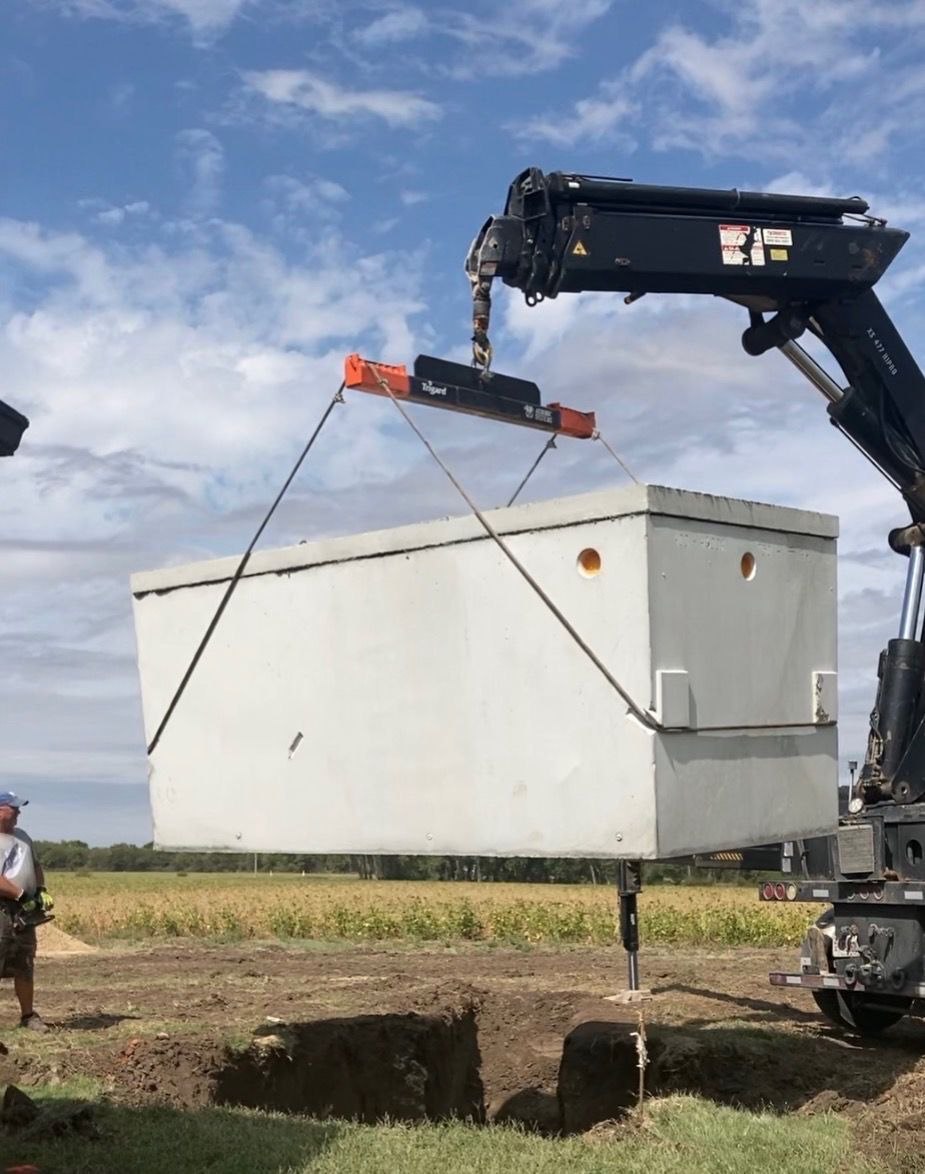
Precast concrete tanks are the most common choice in this part of Kansas, and for good reason. They're heavy enough to stay put, they hold up to the ground movement that comes with freeze-thaw cycles, and they're built to last decades when they're installed correctly and maintained. On rocky ground, setting a concrete tank requires precise excavation — you can't just dig a hole and drop it in when you've got limestone ledge to work around.
Aerobic Treatment Units (ATUs) — Hoot Systems
We've installed Hoot aerobic systems in Ottawa County where high water tables make conventional drain fields impractical. The same logic applies in parts of Lincoln County where shallow bedrock limits soil depth. An aerobic treatment unit treats the effluent to a higher standard before it's dispersed, which means you can sometimes work with less drain field area. These systems have more moving parts and require more maintenance, but in the right situation they're the right answer.
Mound Systems
Where the soil depth is genuinely too shallow for a conventional drain field and an ATU isn't the right fit, a mound system brings the drain field up above grade using imported fill. It's more visible and more expensive to install, but it works where other options don't. On rocky Lincoln County ground, this comes up more than you'd think.
Key insight: Kansas Department of Health and Environment (KDHE) requires a licensed installer and a site evaluation before any new septic system is permitted — and on rocky or shallow-soil properties in Lincoln County, that evaluation often determines which system type is even legal to install at your specific location. Skipping this step doesn't save money; it creates a permit problem and a failed system.
Emergency Septic Repair: When It's Backing Up Inside the House
A septic backup inside the house is not a wait-and-see situation. If you're seeing sewage coming up through a floor drain, a tub, or a toilet that won't flush, the system is telling you something has failed — either the tank is full and needs pumping immediately, there's a clog in the line between the house and the tank, or the drain field has failed and has nowhere to send effluent.
We've been called out to situations like this across Saline, Ottawa, and surrounding counties. The cost of an emergency repair depends on what's actually wrong. A pump-out and line clearing is a very different job than a failed drain field that needs to be replaced. On rocky Lincoln County ground, getting to a clogged or broken line can mean working around limestone that a standard backhoe can't just bite through — it takes the right equipment and someone who knows what they're dealing with.
We run 24/7 emergency service because a backup doesn't wait for Monday morning. If you're dealing with a backup right now, call us at 785-488-7925 — we'll get someone out to you.
For a full look at what we handle on the septic side, visit our septic services page.
Do You Install Septic Near The Falls in Minneapolis KS?
Yes — we serve Minneapolis, KS and the surrounding Lincoln County area. If you're near The Falls or anywhere in Lincoln County and you need a new system installed, an existing system inspected, or emergency repair work done, we're the crew to call. We handle everything from land clearing and site prep through tank setting and lateral line installation. You don't need to hire three different contractors — we do it all.
We've done site prep and septic work across Saline, Ottawa, Lincoln, Dickinson, Ellsworth, and Cloud counties. Rocky ground, tight sites, cedar-covered lots that need clearing before we can even start — that's not unusual for us. If you want to know what your specific property is going to take, reach out and we'll come take a look.
Frequently Asked Questions
How often should rural homeowners and farmers pump their septic tanks in Kansas?
The honest answer is every 3 to 5 years for a typical household, but that number shifts based on how many people are using the system and how old the tank is. A farm family of five using a 1,000-gallon tank is going to fill it faster than a retired couple on a 1,500-gallon tank. If you're running a livestock operation and any wash water is getting near the system, that changes the math too. The rule of thumb we give people: don't wait until you have a problem. Pumping on a schedule is cheap. Replacing a drain field that got overloaded because the tank was never pumped is not cheap.
Do you come out for a free inspection before I hire you?
Give us a call and we'll talk through what you've got going on. For a new install, we want to see the site — the ground conditions, what needs to be cleared, where the house sits relative to where the system needs to go. That site visit is how we give you an accurate quote instead of a number that changes once we show up. Reach out through our contact page or call us directly and we'll get it set up.
Can you handle land clearing and site prep before the septic install?
That's actually one of the things that sets us apart. We're not just a septic crew — we do the land clearing, the demolition if there's an old structure in the way, the excavation, the grading, and the install. One contractor, one mobilization, one job done start to finish. We've cleared cedar-covered lots in Saline County, graded pads, and set tanks all in the same project. If your property needs work before a system can go in, we handle that too. See more about what we do at mikeservicesllc.com.
Does rocky limestone ground in Lincoln County always mean a more expensive septic install?
Not always more expensive, but almost always more involved. The site evaluation matters more, the equipment selection matters more, and the system design has to match what's actually there. We've worked enough rocky ground in this part of Kansas to know what to expect and how to plan for it. The worst outcome is hiring someone who doesn't account for it and ends up with a system that doesn't pass inspection or fails in the first few years. Get the site looked at first — that's the step that protects your investment.
Do I need to be home when you're doing the work?
You don't have to stand there and watch us dig, but we do like to walk the property with you before we start so we're all on the same page about where things are going. Once we've got the plan locked in, our crew can handle the job. We'll let you know when we're done and walk you through what was installed.
Ready to Talk About Your Property?
Whether you're planning a new septic install on a rocky Lincoln County lot, dealing with a backup that needs attention today, or buying land near Minneapolis or Sylvan Grove and want to know what you're working with — give us a call. We serve Saline County, Ottawa County, Lincoln County, Dickinson County, Ellsworth County, Cloud County, and the Salina area.
Call 785-488-7925 for a free quote — or email mradams@twinvalley.net if that's easier. You can also reach us through our contact page. We're available Mon-Fri 8am-5pm, Saturday by appointment, and 24/7 for emergencies.


Comments
Post a Comment