Excavation in Rural Kansas Clay Problems
If you've ever watched a trench wall slump in on itself, or stood in your yard after a hard rain staring at a low spot that won't dry out, you already know what Kansas clay does to excavation work. It's heavy, it shifts, it holds water, and it does not forgive shortcuts. The good news is that a contractor who knows this ground — and has worked it in Saline, Ottawa, Lincoln, and Ellsworth counties for years — can plan around every one of those problems before a bucket ever hits the dirt.
This post is for rural homeowners, farmers, and acreage owners across Central Kansas who are dealing with excavation projects on clay-heavy ground. Whether you're looking at the cost to remove an old septic and install a new one in Kansas, planning fence line trenching and post hole digging, or just trying to figure out what equipment actually shows up when you call a local contractor — here's what you need to know before the work starts.
Why Kansas Clay Makes Excavation Harder Than Most People Expect
Central Kansas soil is not forgiving. Out here in Saline County and the surrounding areas, you're often dealing with heavy clay that expands when wet and cracks when dry. In summer, that dry heat bakes the top layer into something close to concrete, and then a single good rain turns the same ground into something that slides. Below that, you may hit caliche — a calcium carbonate hardpan layer that can stop a standard auger cold.
Here's what that means in practice for the most common excavation jobs:
Trench Cave-Ins
Clay walls look solid when you first open a trench. The problem is that clay is cohesive — it holds together right up until it doesn't. A trench dug in the morning can be fine, and by afternoon, after the walls have had time to dry and stress, sections can slump. A local contractor who knows Saline County clay plans trench depth, width, and shoring before the first pass — not after a wall comes down on a crew member or a pipe. Mike's Services has worked this ground long enough to read it. That's not something you get from a company driving in from Wichita or Kansas City.
Standing Water and Drainage Problems
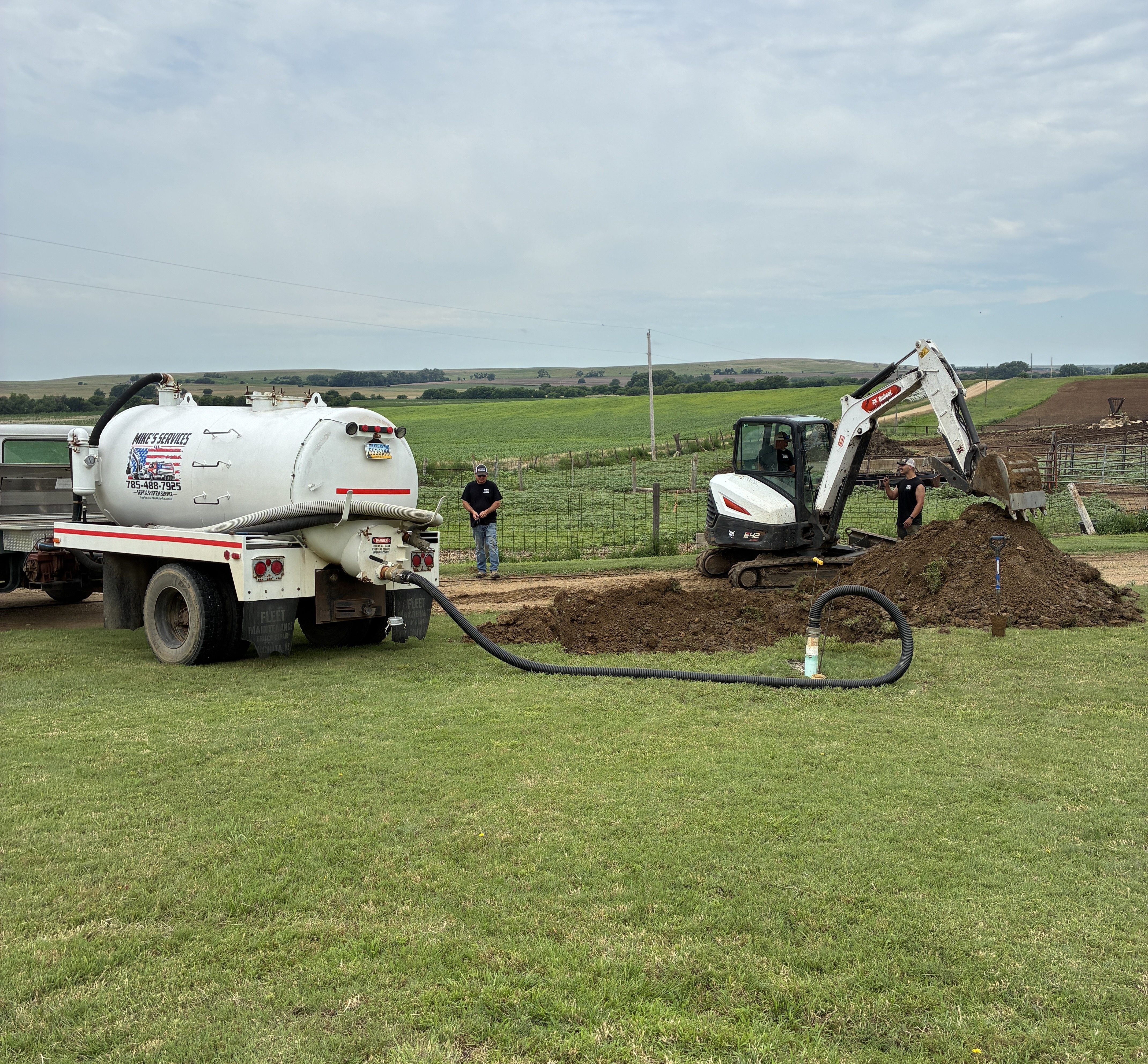
Clay doesn't drain. When you're digging a septic system, a water line repair, or even a simple fence line trench, water that gets into the excavation stays there. That creates problems with pipe bedding, compaction, and the long-term performance of whatever you're installing. On the Barnard job where Mike's crew repaired a clogged septic line, they brought the pump truck specifically to keep the dig dry — sucking the tank down so the crew could work safely and get the line installed correctly. That's the kind of job planning that comes from experience, not a checklist.
Perc Test Failures and Septic Field Placement
In Ottawa County, the water table runs high enough that standard septic systems won't pass a perc test — which is exactly why Mike's crew has installed Hoot systems out there. These aerobic treatment units are designed for high water table conditions and tighter soils. If you're buying rural property or replacing a failing system, the soil type and perc results determine what system you can legally install. Getting a local contractor out to look at your site before you commit to anything can save you from buying a system that won't pass inspection.
Key insight: In Kansas, most rural properties outside of Salina and Abilene are on private septic — which means when a system fails, there's no municipal backup. A failed system in clay soil can back up into the home or surface in the yard within days. Early inspection and proper installation aren't optional — they're what protects your property value and your family's health.
What Equipment Shows Up for Land Clearing and Trenching Jobs
One of the most common questions people ask before they call is: what equipment do you bring for land clearing and trenching? It's a fair question. The right machine for the job matters, especially on clay ground where the wrong approach makes a mess that costs more to fix than the original job.
Mike's Services runs a full equipment lineup that covers the range of excavation work in Central Kansas:
- Komatsu excavator — used for septic installs, water line work, tree and root removal, and deep trenching. On the cedar removal job in Saline County, the excavator pulled the entire root system out of the ground. Cut cedars grow back. Pulled cedars don't.
- Compact tracked loader with mulching head — used for brush clearing, cedar lines, and opening up fence rows. This is what turns a rough field edge into usable ground without tearing up the surrounding area.
- Trenching machine — used for lateral line installation and fence line trenching. Faster and cleaner than using an excavator for straight runs, and more precise for post hole spacing.
- Pump truck — used to pull septic tanks before digging, keep excavations dry, and handle routine maintenance and inspection. Yes, Mike's can pump out septic tanks.
- Grading equipment — used for pad prep, driveway work, and site leveling before a build or septic install.
The short answer to that question is: whatever the job needs. Mike's is an all-in-one operation — land clearing, demolition, excavation, trenching, and septic installation handled by the same crew. You're not coordinating three different contractors and hoping they show up in the right order.
Storm Damage Cleanup: Washed-Out Driveways, Culverts, and What Comes After a Hard Rain
Kansas summer storms hit fast and hit hard. A single night of heavy rain can wash out a gravel driveway, blow a culvert, or carve a new drainage channel through a field. If you've got a low-water crossing that's now a mud pit, or a culvert that's shifted or collapsed, that's an excavation job — and it's one that needs to be handled before the next rain makes it worse.
Mike's Services handles storm damage cleanup including washed-out driveways and culvert repair. The process usually involves:
- Assessing the damage and identifying where water is moving and why
- Excavating the damaged area to expose what's failed — whether that's a collapsed culvert, eroded base, or washed-out fill
- Replacing or repositioning the culvert and rebuilding the base with proper compaction
- Regrading the surrounding area so water moves away from the problem instead of back into it
On clay ground, drainage problems don't fix themselves. If the water found a path once, it'll find it again unless the underlying issue is corrected. Mike's Services works across Saline, Ottawa, Lincoln, Dickinson, Ellsworth, and Cloud counties — and the crew has seen what summer storms do to rural driveways and field crossings out here.
Fence Line Trenching and Post Hole Digging in Kansas Clay
Fence line trenching and post hole digging in Kansas clay is one of those jobs that sounds straightforward until you hit a caliche layer at 18 inches and your auger stops. Or you're trying to run a buried electric line to a shop and the trench keeps slumping because the ground is saturated from a recent rain.
The key to fence line work in clay soil is matching the tool to the condition and knowing when to switch. A trenching machine works well on straight runs in stable ground. An excavator is better when you're dealing with roots, caliche, or unstable walls. Mike's crew has both, and they've done enough fence line and utility trenching across Saline County to know which approach fits which property.
If you're putting in a new fence line and need post holes dug at the same time, that's one visit, one crew, one invoice. No need to schedule a separate contractor for the post holes and another for the trench run.
Frequently Asked Questions
Do I need to be home when the crew is working?
Not necessarily. For most excavation and trenching jobs, the crew can work independently once the scope is clear and access is set. Mike will walk through the job with you upfront so everyone knows what's happening. If something comes up mid-job that changes the plan, you'll hear about it before anything changes — not after.
Can you clear land, build a pad, and install a new septic system — all in one project?
Yes. That's exactly the kind of project Mike's Services is built for. Land clearing, site grading, septic excavation, tank setting, lateral line installation — it all runs through the same crew. You're not waiting on three different contractors to coordinate schedules. One call, one team, one project from start to finish.
What does it actually cost to remove an old septic and install a new one in Kansas?
The honest answer is that it depends on your soil, your system size, your site access, and what's required by your county health department. A property in Ottawa County with a high water table might need a Hoot aerobic system. A property in Saline County on stable clay might be fine with a conventional system. The only way to get a real number is to have someone come out and look at the site. Mike offers free quotes — call and set something up before you start budgeting off numbers you found online.
Can you handle storm damage cleanup — washed-out driveways and culvert repairs?
Yes. If a summer storm took out your driveway crossing or shifted a culvert, that's a job for an excavator and a crew that knows how to grade for drainage. Mike's Services handles that kind of work across Central Kansas. The sooner it gets addressed, the less damage the next rain does. Don't wait until the crossing is completely gone.
Do you come out to inspect before giving a quote?
Yes. For septic work especially, there's no substitute for seeing the property. Soil conditions, slope, existing system location, distance to the house — all of it affects the plan and the price. Mike's doesn't quote blind. You get a real look at the site and a real number, not a guess.
Ready to Talk About Your Project?
Mike's Services LLC works across Saline, Ottawa, Lincoln, Dickinson, Ellsworth, and Cloud counties. Whether you're replacing a failing septic system, clearing a fence line, dealing with storm damage, or starting a new build from scratch — the crew handles it all. One of the best things a recent customer said after a septic install: "I have never met anyone as nice and professional plus their work is second to none." That's the standard every job gets held to.
Mon-Fri 8am-5pm, Saturday by Appointment. 24/7 emergency and after-hours service available.
Call for a free quote: 785-488-7925
Or email: mradams@twinvalley.net
Or visit the contact page at mikeservicesllc.com
More on this service: Excavation and utility trenching in Central Kansas


Comments
Post a Comment