Building Pad Options for Metal Buildings on Central Kansas Properties
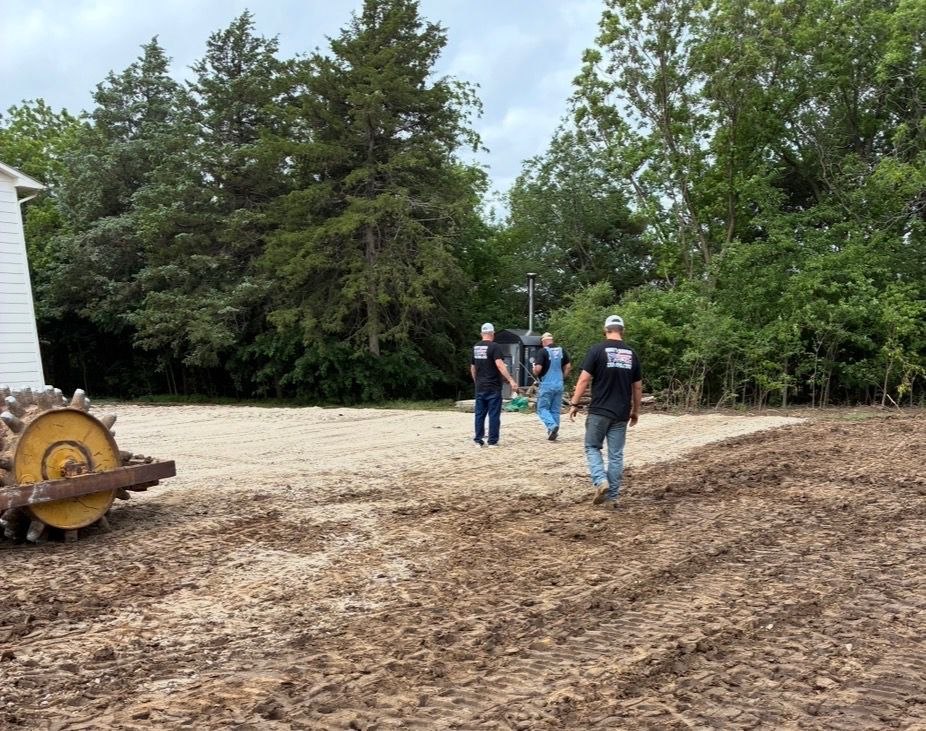
If you're putting up a metal building on your Kansas property and you haven't thought hard about what's going under it, you're setting yourself up for a headache. The clay soil across Saline, Ottawa, and Dickinson counties will shift, heave, and drain poorly if the pad underneath isn't built right from the start — and fixing it after the building is up costs a whole lot more than doing it right the first time.
Whether you're planning a 40x60 shop, a machine storage building, or a full farm equipment barn, the pad it sits on is the most important part of the whole project. This post walks through the real options — gravel versus concrete, what the ground in Central Kansas actually does to both, and what you need to know about house pad construction cost in Kansas before you call anyone out. We'll also answer the questions we hear most often when folks are trying to decide what to do with their property.
Why the Pad Decision Matters More in Kansas Than Most Places
Kansas isn't just flat ground. Out here in Saline County and the surrounding area, you're dealing with heavy clay that holds moisture and expands when it gets wet, then cracks and contracts when it dries out. In a summer like this one — dry heat, cracked soil, temperature swings — that movement is real. Add caliche layers underneath and you've got ground that doesn't behave the way it looks on the surface.
A metal building transfers load differently than a wood-framed structure. The posts anchor into the ground or into a slab, and if the pad underneath isn't stable, you'll see it in the walls and the doors before long. Getting the site prep right before the building crew ever shows up is what separates a pad that lasts 30 years from one that's causing problems in five.
This is also why we always recommend having someone come out and look at your property before you commit to anything. Every piece of ground is different. We've worked on sites in Ottawa County with a caliche shelf sitting 18 inches down, and we've worked on sites in Ellsworth County where the clay runs deep and drainage is the whole conversation. You can't price a pad accurately without seeing what you're working with.
Gravel Pad vs. Concrete Pad: What's Actually Right for Your Metal Building
Gravel Building Pads
A properly built gravel pad is the most common choice for farm buildings in Central Kansas, and when it's done right, it holds up well. The key word is properly. A gravel pad isn't just dumping rock on the ground. It starts with stripping the topsoil, grading and compacting the subgrade, and then building up with the right base material — usually crushed limestone or road base — in compacted lifts.
In clay soil, you also have to think about drainage. Clay doesn't let water pass through, so if you don't crown the pad or slope it correctly, you'll have water sitting under your building after every rain. We've seen plenty of pads out here that were built without that consideration, and the owners end up with a muddy mess every spring and a building that's slowly settling unevenly.
Gravel pads are generally less expensive upfront than poured concrete, and they give you flexibility — you can drive heavy equipment across them and they'll absorb the load better than a slab in some situations. For a general storage building or equipment shed, a well-built gravel pad is a solid choice.
Concrete Building Pads
Concrete makes sense when you need a clean, hard floor — a shop where you're working on equipment, a building where you're storing feed or chemicals, or any structure where you want to keep pests and moisture out from underneath. A concrete slab also gives you a more permanent anchor for the building's posts and walls.
The challenge with concrete in Kansas clay is the ground prep underneath. If the subgrade isn't stable and well-drained before you pour, the slab will crack. That means the excavation and compaction work before the concrete truck ever shows up is just as important as the pour itself. Skipping steps here is where people get into trouble.
Concrete pads cost more upfront — both the material and the prep work — but for a working shop or a building you're putting real money into, it's usually worth it. The site prep cost is a significant part of the total, and that's where working with someone who knows this ground matters.
Key insight: In Saline County and surrounding areas, heavy clay soil can expand and contract by several inches seasonally — meaning a pad built without proper subgrade prep and drainage can shift enough in the first two years to misalign doors, crack walls, and void a metal building's warranty. Subgrade work isn't optional here, it's the whole job.
How We Handle Heavy Clay and Caliche When Building Pads
This is the question we get asked most often once someone finds out we work in this area. Here's the honest answer: it takes the right equipment, the right material, and someone who's done it enough times to know what they're looking at when they dig into it.
When we hit heavy clay, the first thing we're thinking about is moisture and compaction. Clay that's too wet won't compact properly — you'll just be pushing it around. Clay that's too dry can be like digging into concrete. Timing matters, and so does how you handle what you pull out. In most cases, we're not using the native clay as fill material under a pad. We're bringing in crushed limestone or a suitable base material that compacts predictably and drains well.
Caliche is a different animal. It's a calcium carbonate hardpan that forms naturally in the soil profile across a lot of Central Kansas, especially in drier areas. When you hit a caliche layer, you can't just grade over it — it won't drain, and it creates a false bottom that holds water right where you don't want it. Depending on how thick it is and how deep it sits, we may need to break through it, rip it out, or work around it with drainage solutions. We've run into caliche at different depths on properties in Lincoln County and Ottawa County, and every site is a little different.
The short version: this is why a site visit before any quote matters. We can look at your ground, check the slope, and tell you what you're actually working with before anyone starts talking numbers. You can reach out through our contact page to set that up — there's no charge for coming out to look.
What Does Site Prep and Pad Construction Actually Cost in Kansas?
House pad construction cost in Kansas varies more than most people expect, and the biggest variable is what's already on the site and what's in the ground. Here's what drives the number:
- Land clearing and demolition — If there's an old outbuilding, trees, brush, or debris on the site, that work comes first. Demolition and site cleanup in Kansas is a real cost that a lot of people don't factor into their initial budget. We handle all of that — land clearing, demo, hauling — so you're not coordinating multiple contractors.
- Topsoil stripping and subgrade prep — Stripping the organic layer, grading, and compacting the subgrade is where the real work happens. In clay soil, this step can't be rushed.
- Base material — Crushed limestone or road base brought in and compacted in lifts. The amount depends on the size of the pad and what the native soil requires.
- Drainage — Crowning, sloping, and in some cases installing drainage tile or culverts. This is especially important in low spots or areas with poor natural drainage.
- Concrete, if applicable — The pour itself, plus rebar or wire mesh depending on the load requirements.
We're not going to throw a number out here that doesn't mean anything without knowing your site. What we will say is that we do free quotes, and we come out to look before we quote. That's how it should work. Visit mikeservicesllc.com to learn more about what we do, or call us directly and we'll get something scheduled.
Can You Handle the Whole Project — Clearing, Demo, Pad, and Septic?
Yes. This is actually one of the things that sets us apart from a lot of contractors in this area. If you're building on a raw piece of ground — or replacing an old structure — we can handle the land clearing, the demolition and cleanup, the grading and pad construction, and the septic system installation all in one project. You're not calling three different contractors and trying to coordinate schedules. We do it all.
We've done this kind of full-scope work on properties across Saline County, Ottawa County, Dickinson County, and beyond. From clearing cedars and pulling stumps to setting the pad and trenching for septic — it's one crew, one point of contact, and one job done right. If you want to see what that looks like, check out the services page on our site.
FAQ: Building Pads and Site Prep in Central Kansas
Can you come out and look at my property before I decide anything?
Absolutely — and we'd rather do that than quote you blind. Every property is different, especially out here where the soil changes from one county to the next. We come out, walk the site with you, and tell you honestly what we're looking at. No charge for that. Call us at 785-488-7925 and we'll get something on the calendar.
How do you handle heavy clay and caliche soil when building pads?
We don't try to work around it — we deal with it directly. That means assessing moisture conditions before we compact, bringing in proper base material rather than relying on native clay, and breaking through or draining around caliche layers that would otherwise hold water under your pad. We've worked in this ground long enough to know what it does and what it needs. The right equipment and the right approach from the start is what keeps a pad stable for decades.
Do I need to be on the property while you're working?
You don't have to be there every day. We'll walk the site with you before we start so we're all on the same page, and we'll keep you updated as the job moves along. Most of our customers out in rural Saline and surrounding counties have other things going on — we get that. We'll let you know if something comes up that needs a decision.
What if there's an old building or debris on the site that needs to come down first?
That's part of what we do. Demolition and site cleanup in Kansas is something we handle regularly — old outbuildings, sheds, concrete slabs, brush piles, cedar trees. We've got the equipment to take it down, clean it up, and haul it off so the site is ready for the next step. You don't need a separate demo contractor before we can start on the pad.
Do you also install septic systems on the same property?
Yes. We can handle the full scope — land clearing, demo, pad construction, and septic installation. If you're starting from scratch on a rural property, we can take it from raw ground to a finished, ready-to-build site. That includes trenching, tank setting, lateral lines, and everything in between. One crew, one project.
Ready to Talk About Your Property?
If you're planning a metal building, a new structure, or any kind of site prep work in Saline County, Ottawa County, Lincoln County, Dickinson County, Ellsworth County, Cloud County, or the Salina area — give us a call. We come out for free, we give you a straight answer about what your ground needs, and we do the work ourselves from start to finish.
Call 785-488-7925 for a free quote, or email mradams@twinvalley.net to get something scheduled. You can also reach us through our contact page. We're available Monday through Friday 8am–5pm, Saturday by appointment, and 24/7 for emergencies.
More on this service: Building pad and site prep in Central Kansas


Comments
Post a Comment