Acreage Building Site Prep: Stretch One Excavation Visit in Saline County
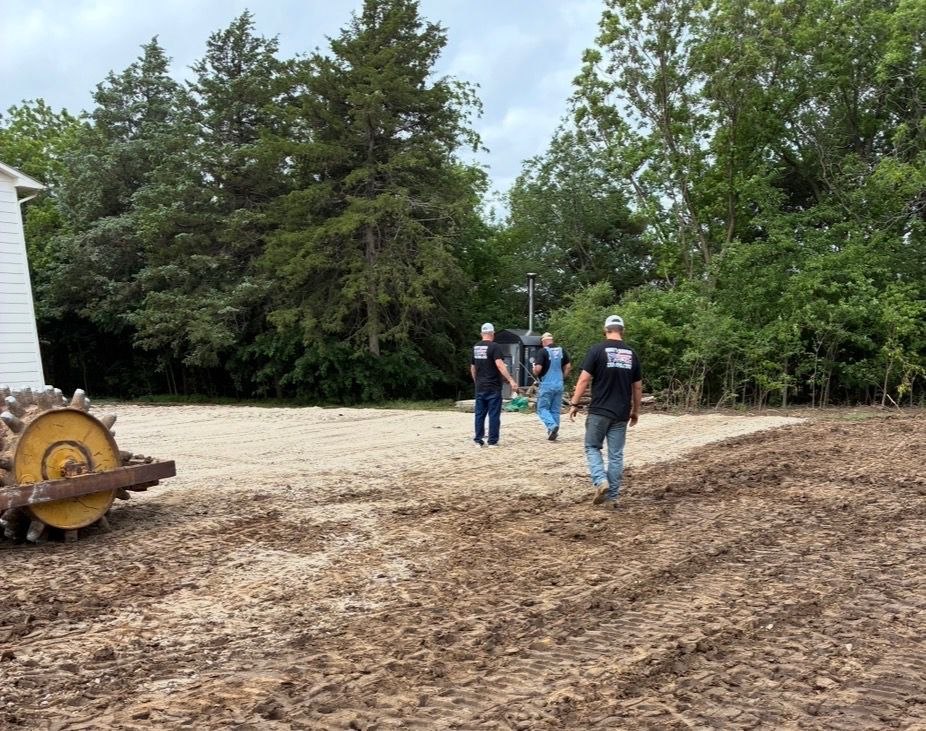
If you're planning a new shop, pole barn, or home on a rural acreage in Saline, Ottawa, or Dickinson County, the single biggest mistake you can make is scheduling your driveway work and your building pad work as two separate jobs. One excavation visit — planned right — can handle both, save you real money, and set your drainage up correctly from the start. Here's how that works and what to expect.
Rural property projects in Central Kansas almost always involve more moving parts than people expect. You've got clay soil that holds water, caliche layers that fight every bucket, and a building site that needs to drain away from your foundation before anything else goes on top of it. Whether you're putting up a 40x60 shop, adding a cattle lot, or building a new farmhouse outside Salina, the excavation work underneath everything else is what determines whether that investment holds up for 30 years or gives you problems in year three. This post breaks down how to combine your driveway and building pad into a single excavation visit — and how foundation drainage around a farmhouse fits into that plan.
Why Rural Acreage Projects Almost Always Need More Than Just a Pad
When people call us, one of the most common questions we get is something like: "Do you work on farm yards and cattle lots or just houses?" The answer is all of it. A building pad for a new home, a graded apron for a cattle lot, a hardened surface for a grain bin — the excavation and grading work is fundamentally the same process. What changes is the drainage plan and the load requirements on top of the pad.
On a typical rural acreage in Saline County, you're dealing with heavy clay soil that does not drain naturally. When it rains, water sits. When it dries out in July and August, that same clay shrinks and cracks. If your building pad isn't graded to push water away from the foundation, you will have water intrusion problems — it's not a question of if, it's when. The same is true for a farmhouse that's been sitting on a lot for 40 years with drainage that was never properly cut in. Foundation drainage around a farmhouse isn't a luxury — it's basic site protection.
The Real Cost Advantage of Combining Driveway and Pad Work
Here's the practical side of this. When we mobilize an excavator and a skid steer to your property, there's a cost to getting that equipment out there. Fuel, operator time, transport — it adds up. If you call us once for the driveway and then call us back three months later for the building pad, you're paying that mobilization cost twice. You're also potentially undoing grading work from the first visit to accommodate the second.
The smarter move — and the one we walk customers through when they're planning — is to look at the whole site at once. Where does the driveway need to run? Where is the pad going? How does water move across this property when it rains hard? If you answer those questions before the first bucket hits the ground, you can often do the rough grading on the driveway approach, set the building pad elevation, cut the drainage swales, and rough in the septic field area all in the same mobilization.
- One equipment mobilization instead of two or three
- Drainage planned as a system, not patched together after the fact
- Septic field location confirmed before the pad is set — not after
- Driveway approach graded to match final pad elevation from the start
- Less disturbance to the surrounding yard and existing vegetation
We've done this kind of combined work all across Saline, Ottawa, Lincoln, and Dickinson counties. It's not a complicated idea — it just takes someone who does land clearing, excavation, and septic work under one roof so the planning actually connects. You can learn more about what we handle at mikeservicesllc.com.
Foundation Drainage Around a Farmhouse: What to Actually Fix
If you've got an older farmhouse in rural Saline or Ellsworth County and you've noticed soft spots in the yard, water pooling near the foundation after rain, or a basement that smells musty every spring — the drainage around that structure probably needs attention. This is one of the most common calls we get from people who've bought rural property and are starting to realize what the previous owners never dealt with.
Grading Away from the Foundation
The first fix is almost always the grade. Soil around an older farmhouse tends to settle over decades, and what was once a slight slope away from the house becomes flat or even slopes toward it. Regrading the immediate perimeter so water sheds away from the foundation is straightforward excavation work — but it has to be done carefully so you don't disturb existing utilities or septic lines.
French Drains and Swales
In heavy clay soil — which is most of what you're dealing with in Central Kansas — a French drain or a cut swale can intercept water before it ever reaches the foundation. We trench these in, set perforated pipe where needed, and route the flow to a low point on the property that won't cause problems downstream. This is the same trenching work we do for septic laterals, so if you're also planning a septic upgrade, it often makes sense to do both at once.
Downspout and Surface Water Management
On a farmhouse with a large roof, downspouts can dump a significant amount of water right at the foundation during a heavy rain. Extending those away from the structure and routing them into a graded swale is a small piece of the overall drainage picture — but it matters, especially on properties where the soil is already slow to drain.
Key insight: In heavy clay soils like those found across Saline and Ottawa counties in Kansas, water moves laterally through the soil much faster than it moves downward — meaning a building pad or farmhouse foundation without proper surface grading can collect water from a surprisingly wide area, not just what falls directly on the site. Getting the grade right before you build is far cheaper than fixing drainage problems after the slab is poured.
Yes, We Work on Farm Yards, Cattle Lots, and Rural Properties — Not Just Houses
We get this question a lot. The short answer is yes — if it needs to be graded, cleared, excavated, or drained, we can handle it. Farm yards, cattle lot pads, grain bin sites, rural shop pads, acreage driveways — all of it. We've done city water line work out in Falun, septic maintenance in Beverly, Hoot system installs in Ottawa County for high water table situations, and land clearing in Saline County where cedar roots had to come out completely so they wouldn't grow back. The equipment and the crew travel.
We also do the full package when you're starting from scratch on a rural property: land clearing, demolition of old structures, building pad grading, driveway approach, and septic installation. That's not something every contractor around Salina can offer under one roof. When you're trying to stretch your budget on a rural build, having one contractor who can sequence all of that work — and plan it together — makes a real difference. Reach out here if you want to talk through what your project involves before you commit to anything.
Frequently Asked Questions
Do you offer emergency septic and excavation help after storms or tornadoes?
Yes. We offer 24/7 emergency service. If a storm has damaged your septic system, flooded your drain field, shifted a tank, or you've got a water line break that can't wait — call us. We've responded to emergency calls across Saline, Ottawa, Lincoln, Dickinson, Ellsworth, and Cloud counties. Don't wait on something like that. Call 7854887925 any time.
Do you come out to look at the property before I have to commit to anything?
We offer free quotes. If you've got a rural property in Central Kansas and you're trying to figure out what a building pad, driveway, drainage fix, or septic install is going to cost — we'll come out and take a look. You don't need to have everything figured out before you call. That's what the site visit is for.
Do you land clear, build a pad, and install a septic system — all three?
Yes, that's exactly what we do. You don't have to hire three different contractors and try to coordinate their schedules. We can clear the trees and brush, grade and build your building pad, and install your septic system. That's one of the main reasons people call us instead of piecing it together with different crews. It's simpler, it's usually faster, and the drainage planning actually makes sense when one crew is thinking about all of it together.
Do I need to be on-site during the work?
Not necessarily. A lot of our customers are farmers or working folks who can't be standing around watching a machine grade a pad all day — and that's fine. We'll walk through the plan with you before we start, confirm the key decisions, and keep you updated. For septic work specifically, we don't need to go inside your home. We work outside at the tank and field, so you don't need to arrange anything special inside the house.
How does clay soil in Saline County affect building pad and drainage work?
It matters a lot. Clay doesn't drain the way sandy or loamy soil does, so the grade on your pad and the drainage swales around it have to be cut correctly — water has to have somewhere to go on the surface, because it's not going to disappear into the ground quickly. Caliche layers also show up in parts of Saline and Ottawa counties, and those can make excavation harder and perc tests more important for septic planning. We've been working this soil for years, so we account for it in how we plan the job.
Ready to Plan Your Site Prep? Call for a Free Quote.
If you're planning an acreage build, need foundation drainage fixed around an existing farmhouse, or want to talk through how to combine your driveway and building pad into one efficient excavation visit — give us a call. Mike's Services LLC serves Saline, Ottawa, Lincoln, Dickinson, Ellsworth, and Cloud counties, and we're available 24/7 for emergencies. Regular hours are Monday through Friday, 8am to 5pm, and Saturday by appointment.
Call us at 7854887925, email us at mradams@twinvalley.net, or fill out the form at mikeservicesllc.com/contact.html. We'll come out, look at your property, and give you a straight answer on what it's going to take.


Comments
Post a Comment